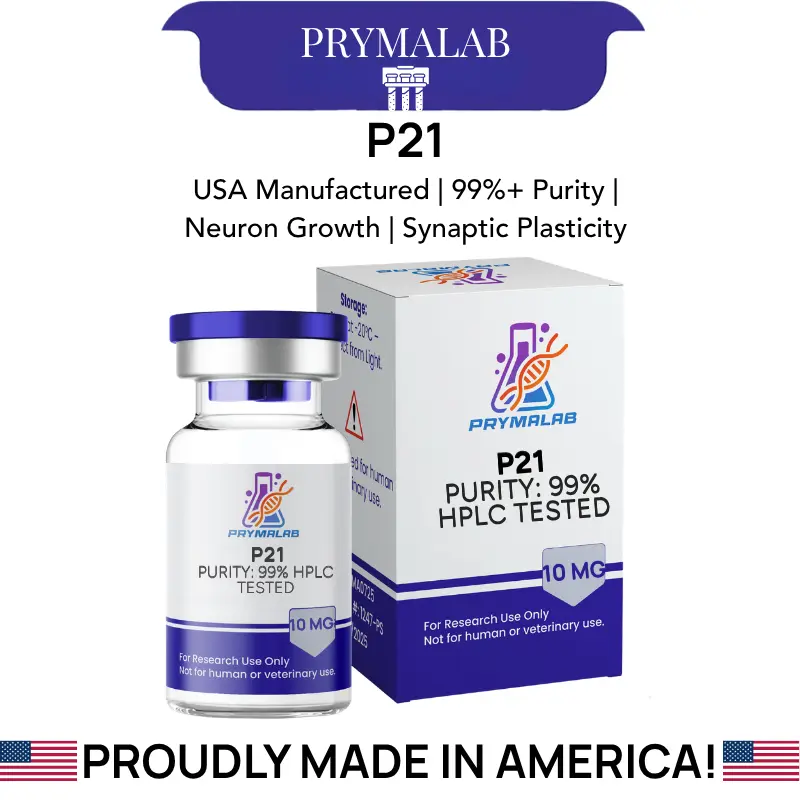
P21 peptide 10mg is an extended-supply lyophilized vial of P021, the adamantylated CNTF-derived peptide mimetic. Ten milligrams is twice the standard fill, intended for programmes long enough that single-lot continuity becomes worth having, particularly given the modified structure.
Specification Table
P021 verified data, 10mg extended-supply format
| Property |
Value |
| Compound |
P021 |
| Vial content |
10 mg lyophilized powder |
| Relationship to 5mg format |
Identical compound at twice the fill weight |
| Common designation |
P21 |
| Structure |
Ac-DGGLAG-NH2 with an adamantylated C-terminal glycine |
| Core sequence origin |
Ciliary neurotrophic factor (CNTF), residues 148 to 151 |
| Core tetrapeptide |
Asp-Gly-Gly-Leu (DGGL) |
| N-terminal modification |
Acetylation |
| C-terminal modification |
Amidation, with adamantylated glycine |
| Purpose of adamantane group |
Raises lipophilicity and blood-brain barrier permeability, reduces exopeptidase degradation |
| Reported mechanism |
Competitive inhibition of leukemia inhibitory factor (LIF) signalling |
| Reported downstream findings |
Increased BDNF expression, reduced GSK3β activity |
| Reported model readouts |
Dentate gyrus neurogenesis, dendritic and synaptic complexity in rodent models |
| Originating group |
Khalid Iqbal and colleagues, New York State Institute for Basic Research |
| Oral activity |
Reported as orally bioavailable in the primary literature |
| Appearance |
White lyophilized powder |
| Purity |
Per lot-specific certificate of analysis |
| Solubility |
Soluble in water and in dilute aqueous buffers |
| Storage, lyophilized |
-20°C, protected from light and moisture |
| Storage, reconstituted |
2-8°C, protected from light |
| Human clinical data |
None published |
| Regulatory status |
No approved human or veterinary formulation in any jurisdiction |
What Does Oral Bioavailability Mean for a Peptide?
The primary literature describes P021 as orally bioavailable, which is an unusual property for anything peptide-derived and worth examining rather than accepting at face value.
A conventional peptide taken orally encounters gastric acid, pepsin, and the full pancreatic protease complement in the small intestine. Very little survives intact, and what does must then cross the intestinal epithelium, which short polar peptides do poorly without a transporter.
P021 addresses both barriers through its modifications rather than through size alone. Acetylation of the amino terminus and amidation of the carboxy terminus remove the charged groups exopeptidases recognise, and the adamantylated glycine adds bulk at the C-terminus and raises lipophilicity, which assists passive membrane permeation.
Whether those modifications are sufficient in practice is an empirical question the primary literature addresses in rodent models. For a researcher, the practical implication is that route of exposure is a variable worth controlling explicitly, since a compound that survives oral exposure in a mouse may behave differently in another system.
This property also distinguishes P021 from most peptides in this catalogue, nearly all of which are supplied for parenteral routes in research settings for exactly the reasons above.
How Should the BDNF and GSK3β Findings Be Read?
Two downstream observations recur in the literature, and the relationship between them is proposed rather than independently established.
BDNF is among the most measured molecules in neuroscience, and expression changes are reported in response to a very wide range of interventions. That ubiquity cuts both ways: it makes BDNF a convenient readout and a weak discriminator, because many things move it.
GSK3β activity sits downstream of several pathways, and reduced activity is likewise reported across many contexts. The published proposal is that the GSK3β change follows from the BDNF change rather than arising separately.
Testing that ordering requires more than measuring both. A time course showing BDNF change preceding GSK3β change is suggestive. Blocking BDNF signalling, through TrkB antagonism or BDNF sequestration, and showing the GSK3β effect disappears would be conclusive.
Designs measuring both endpoints and reporting them as parallel findings, without testing the dependency, are common in this area and support a weaker claim than they usually make.
What Analytical Confirmation Suits a Modified Peptide?
The modifications that make P021 useful also make it harder to characterise with default methods, and knowing where the pitfalls sit saves time.
Mass spectrometry confirms the total mass including all three modifications. What matters is checking against the modified mass rather than the unmodified core sequence, since a preparation missing the adamantyl group would show a substantially lower mass and might otherwise be read as a different compound entirely.
Reversed-phase chromatography behaves differently than for an unmodified short peptide. The adamantyl group increases retention considerably, so a method developed for polar peptides will need adjusting, and a preparation eluting early may indicate incomplete modification.
Nuclear magnetic resonance confirms the adamantane is present and correctly attached, which mass alone cannot fully establish, since an adamantyl group attached at the wrong position would give the same mass.
Amino acid analysis confirms the core composition independently of the synthesis record, and for a construct combining natural residues with a synthetic modification that independent confirmation has real value.
When Is the Larger Vial Worth It for P21 Peptide 10mg Work?
Two arguments favour it and one argues against, and for this compound the balance tilts further toward the larger format than it does for a simple peptide.
Lot continuity is the stronger argument here than for an unmodified sequence. P021 involves three separate modifications on a short core, and the efficiency of each contributes to lot-to-lot variation in the proportion of fully modified product. A partially modified fraction differs from the target in both lipophilicity and stability.
Throughput is the second. Rodent work consumes considerably more material than cell assays, and studies in this area typically run for weeks, so purchasing intervals become an operational consideration.
Against both, an amphipathic molecule reconstituted in bulk and held in solution presents more opportunity for adsorptive loss and for precipitation on storage than a small quantity used quickly. Aliquoting addresses it, and the aliquots should be checked visually before use rather than assumed clear.
How Should P21 Peptide 10mg Work Handle Route and Vehicle?
Two variables are routinely under-reported in work with this compound, and both become more consequential when a single lot spans an extended study.
Route is the first. Since the primary literature describes oral bioavailability, studies in this area have used both oral and parenteral exposure, and the two are not interchangeable. Oral exposure introduces first-pass metabolism and gut wall processing that parenteral exposure bypasses entirely.
A finding obtained by one route constrains conclusions about the other only weakly. Reporting the route explicitly, rather than leaving it in a preparationary methods table, is what allows a reader to place the finding correctly.
Vehicle is the second. The adamantyl group makes aqueous dissolution slower than for a plain peptide, and where a co-solvent is used it becomes part of the experimental system rather than an inert background.
Dimethyl sulfoxide, ethanol and cyclodextrin formulations all have their own effects, and cyclodextrins in particular alter the availability of lipophilic compounds by sequestering them, which is precisely why they are used and precisely why they complicate interpretation.
A vehicle-only control run alongside every condition addresses it, and stating the final vehicle composition in the methods rather than only the compound concentration is the minimum that makes a study reproducible.
What Does Lot Variation Look Like for a Triply Modified Peptide?
Three modifications on a six-residue core means three opportunities for incomplete conversion, and the impurity profile that follows is more informative than a single purity number.
Incomplete amino-terminal acetylation leaves a free amine, producing a species 42 daltons lighter with different charge and different protease susceptibility. It is straightforward to detect by mass spectrometry if the analysis looks for it.
Incomplete carboxy-terminal amidation leaves a free acid, one dalton heavier than the amide, which requires high-resolution instrumentation to resolve and is consequently the modification most often missed in routine analysis.
Incomplete adamantylation is the most consequential and the easiest to see, since the missing group represents a substantial mass difference and a large shift in chromatographic retention. A preparation with a significant unadamantylated fraction is a different compound in solubility and permeability terms.
Requesting the impurity profile rather than only the purity percentage is what surfaces these. A lot that is ninety-five percent pure with the remaining five percent being unadamantylated material is not equivalent to one where the impurities are unrelated synthesis by-products.
When Does P21 Peptide 10mg Justify the Larger Fill?
Two situations make the extended format the better purchase, and neither is simply about running out.
The first is a study long enough that a lot change would fall inside it. For a triply modified peptide the proportion of fully modified product varies between syntheses, and P21 peptide 10mg holds that constant across the whole series.
The second is in vivo work, which consumes material at a rate that makes repeated small purchases impractical and that would otherwise force a lot change mid-study for reasons of supply rather than design.
Against those, a larger fill reconstituted in bulk sits in solution longer, and an amphipathic molecule in solution has more opportunity to adsorb and to come out of solution than one used quickly.
Aliquoting resolves it. Inspect each aliquot for clarity before use rather than assuming it.
Reconstitution and Storage in Laboratory Practice
Dissolution requires more patience than for a plain short peptide, because the adamantyl group resists aqueous solvation while the core sequence favours it.
Add diluent slowly against the vial wall and allow time. Where dissolution stalls, gentle warming to room temperature is preferable to agitation, and a small proportion of organic co-solvent is used in some published preparations. Any co-solvent used becomes a vehicle-control requirement downstream and should be recorded as such.
Amphipathic character increases surface adsorption, so low-binding consumables are worth using and a carrier protein is worth considering where the downstream assay tolerates it.
Dry material belongs at -20°C, sealed against both light and moisture. Reconstituted solution at 2-8°C in the dark, aliquoted before freezing, and inspected for clarity before each use. Record lot, diluent, any co-solvent, volume, concentration and date.
Published Literature
Citations checked against the publisher record or a primary index. As with the 5mg format, the work originates predominantly from one research group.
- Chohan MO, Li B, Blanchard J, Tung YC, Heaney AT, Rabe A, Iqbal K, Grundke-Iqbal I. Neurobiology of Aging. 2011;32(8):1420-1434.
- Kazim SF, Blanchard J, Dai CL, Tung YC, LaFerla FM, Iqbal IG, Iqbal K. Neurobiology of Disease. 2014;71:110-130.
- Bolognin S, Buffelli M, Puoliväli J, Iqbal K. Neurobiology of Aging. 2014;35(9):2134-2146.
- Baazaoui N, Iqbal K. Journal of Alzheimer’s Disease. 2017;58(1):215-230.
- Khatoon S, Chalbot S, Bolognin S, Puoliväli J, Iqbal K. Journal of Alzheimer’s Disease. 2015;47(2):373-386.
Frequently Asked Questions
What is P21 peptide 10mg?
An extended-supply lyophilized vial of P021, the adamantylated CNTF-derived peptide mimetic, at twice the standard fill, identical to the 5mg format at a larger fill weight. Sold for laboratory research alone, with no approval anywhere for human or veterinary use.
What does oral bioavailability mean for a peptide?
It is unusual. A conventional peptide taken orally meets gastric acid, pepsin and pancreatic proteases, and very little survives intact, so P021 addresses that through terminal acetylation and amidation removing the groups exopeptidases recognise, plus the adamantyl group raising lipophilicity.
Does that distinguish it from other peptides here?
Considerably. Nearly every peptide in this catalogue is supplied for parenteral routes in research settings precisely because oral exposure destroys them, but P021 is the exception, and route of exposure therefore becomes a variable worth controlling explicitly rather than assuming.
How should BDNF findings be interpreted?
With some caution. BDNF is among the most measured molecules in neuroscience and expression changes are reported across a very wide range of interventions. That ubiquity makes it a convenient readout and a weak discriminator, because many things move it.
Is the BDNF to GSK3-beta relationship established?
Proposed rather than established. Testing the ordering requires more than measuring both. A time course showing BDNF change preceding the GSK3-beta change is suggestive, and blocking BDNF signalling to show the GSK3-beta effect disappears would be conclusive.
What should mass spectrometry be checked against?
The modified mass, including acetylation, amidation and the adamantyl group, rather than the unmodified core sequence, since a preparation missing the adamantyl group would show a substantially lower mass and could be misread as a different compound entirely.
Why does chromatography behave differently?
The adamantyl group increases retention considerably on a reversed-phase column, so a method developed for polar peptides needs adjusting. A preparation eluting earlier than expected may indicate incomplete modification rather than a chromatography problem.
What does NMR add over mass spectrometry?
Confirmation that the adamantane is attached at the correct position. An adamantyl group attached at the wrong site would give an identical mass, so mass spectrometry alone cannot distinguish correct from incorrect attachment.
Why does lot continuity matter more for this compound?
Because P021 involves three separate modifications on a short core, and the efficiency of each contributes to lot-to-lot variation in the proportion of fully modified product. A partially modified fraction differs from the target in both lipophilicity and stability.
How should dissolution be handled?
With more patience than a plain short peptide, since the adamantyl group resists aqueous solvation while the core favours it. Add diluent slowly and allow time. Where dissolution stalls, gentle warming is preferable to agitation, and any co-solvent used should be recorded.
Compliance Statement
P21 peptide 10mg is sold exclusively for laboratory research use. It is not a drug, food, or cosmetic product, and it is not a dietary product of any kind. It is not approved by the FDA or any comparable authority for human or veterinary use, and no human clinical study of this compound has been published. This product is not intended to diagnose, treat, cure, or prevent any disease. It must not be given to humans or animals. Purchase is restricted to qualified researchers and institutions operating within applicable laws. All handling is the responsibility of the purchasing laboratory.












Reviews
There are no reviews yet.